
A lack of ordinary care does not cause all car wrecks. Sudden wind gusts, lightning strikes, earthquakes, and other natural disasters cause a handful of these incidents. Moreover, not all driver error is negligence. For example, rolling down the window is not something that most people would consider negligent, even though this act constitutes distracted driving.
Yet negligence causes the overwhelming majority of vehicle collisions. To obtain compensation for your injuries, the negligence must involve a lack of ordinary care or, sometimes, a violation of a safety law.
Compensation & Medical Bills
This compensation is very important in car crash cases. The resulting medical bills are usually overwhelming. Making matters worse, many health insurance companies do not cover these expenses. Instead, they cite liability concerns and refuse payment. The compensatory damages also include money for loss of consortium (companionship), pain and suffering, loss of enjoyment in life, emotional distress, and other non economic losses.
Third party
In many cases, a third party, like an employer or a bar, may be responsible for damages. Almost all jurisdictions recognize the respondent superior (employer liability) rule, and many jurisdictions have broad dram shop laws.
Vicarious liability is very important in catastrophic injury cases. Third party liability gives victims an added source of recovery. So, it’s easier for them to get the medical treatment they need from an experienced car crash physician.
Behavioral Negligence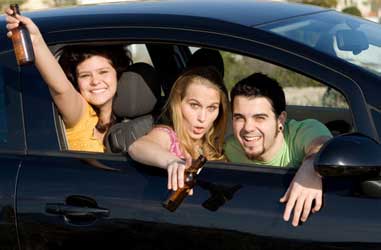
Sometimes, a lack of care has very little to do with the way the tortfeasor (negligent driver) operated the vehicle. Instead, the tortfeasor made a choice, or series of choices, which led inexorably to a car crash.
Substance impairment is perhaps the most common type of behavioral negligence. Alcohol causes about a third of the fatal crashes in the United States. This substance impairs motor skills and inhibits judgement. When people operate heavy machinery, such as motor vehicles, both these skills must be fully functional. A slight impairment can cause serious problems.
Indeed, alcohol impairment begins with the first drink. That’s different from legal intoxication in criminal court. Generally, a person must consume at least three or four drinks before the person’s BAC exceeds the legal limit.
Alcohol is not the only impairing substance. Many drugs have a similar effect on judgement ability and motor skills. These drugs can be:
- Street drugs, like LSD and crack cocaine,
- Prescription drugs, like Oxycontin and Percocet, or
- Over-the-counter drugs, like Sominex and NyQuil.
There’s also some evidence that marijuana inhibits driving skills. Then again, there’s also some evidence that marijuana does not significantly alter a person’s ability to drive.
Note that it is legal to consume over-the-counter drugs, prescription drugs, and even marijuana in some cases. However, just like it’s illegal to drive under the influence of alcohol, it’s illegal to drive under the influence of drugs.
Fatigue is also a form of behavioral negligence. Drowsiness and alcohol affect the brain in about the same way. After people have been awake for just ten hours, their minds function as though they have a .05 BAC. In other words, these individuals are dangerously impaired before they get behind the wheel.
 Operational Negligence
This category refers to traffic infractions and other such violations. Much like behavioral negligence, operational negligence can involve either:
- Negligence (lack of ordinary care), or
- Negligence per se (the violation of a safety statute).
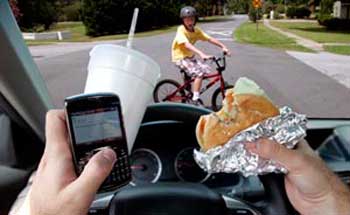
The most common forms of operational negligence are distracted driving, illegal turns, and speeding.
Distracted driving is a broad term which includes a number of behaviors, such as using a cellphone while driving, eating while driving, talking to passengers while driving, and so on. Significantly, hands-free cellphones may be more dangerous than hand-held cell phones. Hands-free gadgets distract drivers both cognitively (mind off driving) and visually (eyes off the road). These devices also give many drivers a false sense of security.
Illegal turns usually involve either unsafe lane changes or left turns against traffic. Illegal turns cause about a third of vehicle-on-motorcycle collisions. Many times, drivers simply do not maintain a proper lookout for motorcycle riders. This lookout is especially difficult if there are a lot of pickup trucks and SUVs on the road at the time. That’s normally the case in most areas.
Excessive velocity is a factor in about a third of the fatal crashes in the United States. Speeding increases both the risk of a collision and the force in a collision. Speed multiples stopping distance, which is the ground that a vehicle covers between the time the driver sees a hazard and the car stops. Speed also multiples the force in a collision. Excessive velocity transforms fender-benders into serious injury collisions. Speed also transforms small objects, like cellphones, into high-speed projectiles.
Environmental Negligence
The duty of reasonable care requires drivers to adjust their driving habits if environmental conditions warrant such an adjustment. The law requires the same thing, in many cases.
Vehicle speed is a good example. In most jurisdictions, the posted speed limit is not an absolute rule. Instead, the speed limit is presumed to be a reasonable speed for that roadway under ideal conditions. If the sky is dark, the road is slick, or conditions are otherwise less than ideal, drivers have a duty to slow down.
Environmental negligence sometimes involves the negligence per se rule. Things like going too fast for the conditions, failing to use headlights in darkness, and failing to use windshield wipers in the rain are all violations of the law in most jurisdictions.
But most frequently, environmental negligence involves a lack of ordinary care. In addition to showing a lack of care, victim/plaintiffs must also prove that there was a connection between the lack of care and their damages.
If you were in a car crash, instead of worrying about medical bills, contact us and let us connect you with the treatment provider you need.
 Since 2012,